You looked up once and it was 9:15. You looked up again and it was 1:40. Nothing dramatic happened in between, and you cannot really account for the hours. If that feels familiar, you are not careless with time. You may be living with time blindness, one of the most common and least discussed parts of adult ADHD.
You would also be far from alone. The CDC estimates that 15.5 million US adults, about 1 in 16, currently have an ADHD diagnosis, and that more than half of them (55.9%) were diagnosed as adults rather than as children. Many people only find the name for what keeps eating their afternoons long after school is over.

What time blindness actually is
Time blindness is difficulty sensing the passage of time and estimating how long things take. Most people carry a rough internal clock that ticks along in the background. With ADHD, that clock runs unevenly. Time becomes two categories: now and not now. A deadline three weeks away sits in exactly the same mental drawer as a deadline three months away, right up until it becomes terrifyingly now.
This is not a character flaw or a motivation problem. Time perception is one of the executive functions that ADHD affects, alongside working memory and planning; all five areas are covered in our guide to executive function and ADHD. Advocacy organizations such as CHADD have written about it for years.
The four ways time blindness shows up in a normal week
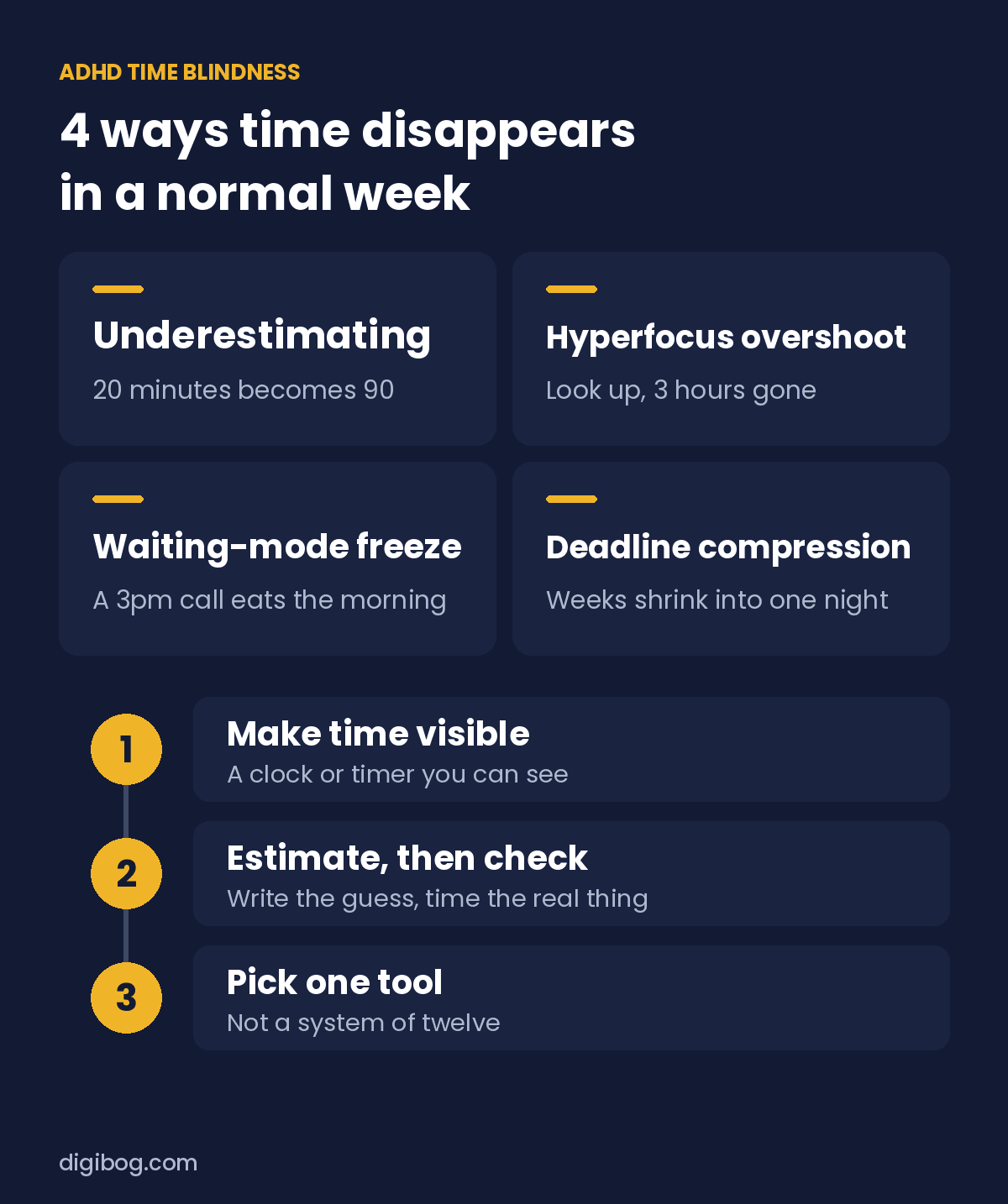
- Underestimating. A task you think will take twenty minutes takes ninety. You plan your day around the twenty.
- Hyperfocus overshoot. You start something interesting and look up three hours later, having missed everything else you planned.
- The waiting-mode freeze. You have a call at 3pm, so the whole morning before it becomes unusable. You cannot start anything because the appointment is coming.
- Deadline compression. Weeks of available time shrink into one panicked night, and the work gets done through adrenaline rather than planning.
None of these are solved by trying harder. You cannot will an internal clock into existence. What you can do is put the clock outside your head, in three moves: make time visible, estimate and then check, and pick one tool instead of twelve.
Here is each pattern with the simplest way to make it visible:
| Pattern | What it feels like | Make it visible |
|---|---|---|
| Underestimating | “This will take 20 minutes” | Time the task once, write the real number |
| Hyperfocus overshoot | Looking up three hours later | An alarm on the other side of the room |
| Waiting-mode freeze | The morning lost to a 3pm call | Book a 25-minute task with a timer |
| Deadline compression | Everything happens the night before | Put three fake deadlines in the calendar |
1. Make time visible instead of imagined
The single most useful shift is moving time out of your mind and into something you can see. When time is abstract, your brain has nothing to work with. When it is physical and visible, estimating becomes possible.
- Use a timer you can see, not just hear. A visual countdown that shrinks as time passes gives constant feedback. A silent phone timer in your pocket does nothing.
- Give every task a container. Not “work on the proposal” but “proposal, 45 minutes, then stop and reassess.” Open-ended tasks expand to fill whatever is available.
- Build in transition time. Most ADHD schedules fail because they assume you teleport between tasks. Add ten minutes between blocks and the whole day stops collapsing.
- Anchor to fixed points. Tie work blocks to things that already happen at the same time each day, like a meal or a school run. Anchors are easier to feel than abstract clock times.
2. Estimate, then check: a five-minute experiment
Do not redesign your whole system. Try this instead. Pick one task you do regularly and always misjudge. Before you start it, write down how long you think it will take. Start a visible timer. When you finish, write the real number next to your guess. Do this for five days with the same task.
By Friday you will know your personal multiplier. Most people find they are off by a fairly predictable factor, and that one number changes how you plan everything else. It is not a cure for time blindness, but it turns an invisible problem into a measurable one, and measurable problems can be worked with.
3. Pick one tool, not a system of twelve
The instinct when time keeps slipping is to install five new apps. That usually makes things worse. Every new tool is another thing to check, another notification, another place your attention can leak.
Choose one external time anchor and use it for a month before adding anything: a visual timer, a single calendar with realistic blocks, or one tracking app. If you want a starting point, our list of the best ADHD productivity tools sorts them by the job they do. For a fuller shortlist, the Productivity with ADHD Toolstack reviews 24 tools across time awareness, focus, organization and habits, with space to note what you tested and what you kept.
Make time visible on paper, not in another app
Productivity with ADHD — Workbook is a 16-page fillable PDF with 22 exercises. Several of them are about time specifically: estimating it, watching it pass, and catching the hours that disappear.
See the exercisesInstant download · unlimited downloads · no expiry · one payment, no subscriptionWork with your energy, not against the clock
Time blindness gets worse when you are depleted. A task that takes 30 minutes at your sharpest can take two hours when you are running on empty, and you will still schedule it as a 30-minute job.
This is why energy-based planning tends to work better than strict hour-by-hour scheduling. Instead of assigning tasks to times, assign them to states: deep focus work in your high-energy window, routine admin in the dip, low-stakes tidying when you are done for the day. You stop fighting your own rhythm and start using it.
Our Productivity with ADHD Guide walks through this in detail, including how to map your own high, steady and low energy windows and build flexible time blocks around them rather than a rigid timetable that breaks by Tuesday.
Frequently asked questions
Is time blindness an official diagnosis?
No. It is a widely used description of difficulty sensing and estimating time, which is one of the executive functions that ADHD affects. It is not a diagnostic term in its own right.
Can people without ADHD have time blindness?
Everyone misjudges time sometimes. With ADHD it tends to be more frequent and more costly, which is why making time visible outside your head helps so much.
How long does the five-minute experiment take to show results?
About five days with the same task. By then most people can see a fairly steady gap between their guess and the real time, and that one number changes how they plan everything else.
Is a phone timer enough?
A timer you can see works better than one you can only hear. A visual countdown gives constant feedback; a silent timer in a pocket gives none until it goes off.
What helps with hyperfocus overshoot?
A physical alarm on the other side of the room, so stopping it means standing up. Decide before you start what you will do when it rings, or it is easy to switch it off and keep going.
Progress, not perfection
Time blindness does not disappear. What changes is how much it costs you. When time lives outside your head, on a timer, in a block, on a page, you stop relying on a sense you do not reliably have. The lost afternoons get shorter. The panicked nights get rarer.
Start with one visible timer and one honest estimate. That is enough for this week.
You can browse the full Productivity with ADHD collection — book, workbook, guide, prompts, toolstack and checklist — or take all six together in the Complete Bundle.
This is an educational and organizational resource, not medical advice. If time management difficulties are significantly affecting your work or wellbeing, a qualified healthcare professional can help you explore what is going on.
About the author. Written by Said Sihame, founder of DigiBog. I make the planners, workbooks and checklists sold on this site, and these articles come out of the same work. I am not a clinician and nothing here is medical advice — this is an educational and organizational resource.