You already know something other people would pay to learn. The hard part is not the knowledge; it is the steps to create your first online course that is structured, priced, and actually ready to sell. Most would-be creators get stuck here and never launch.
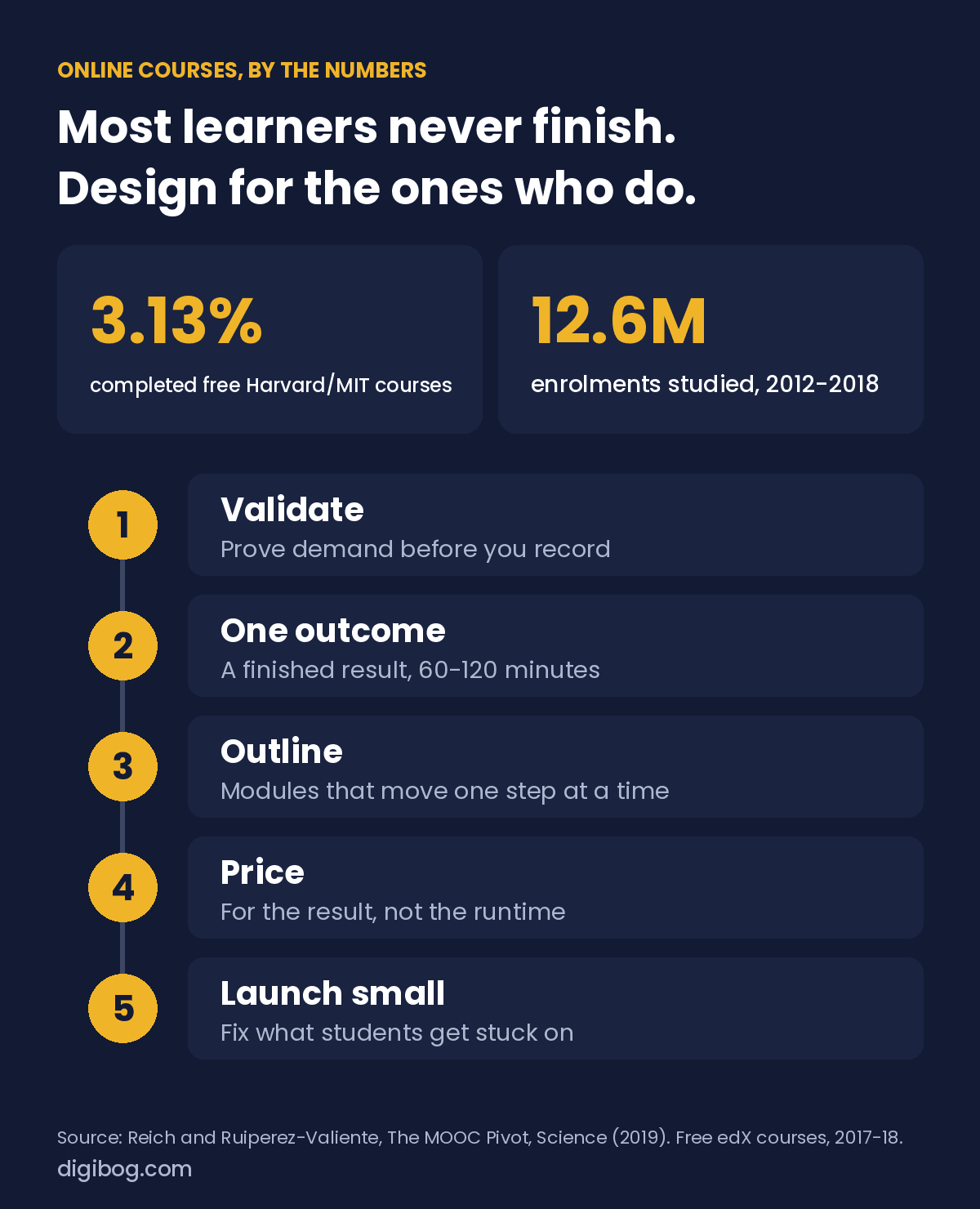
And the courses that do launch have a second problem: people do not finish them. When MIT researchers looked at 12.6 million enrolments in free Harvard and MIT courses on edX, only 3.13% of learners completed their course in 2017-18. Free courses are an extreme case, and paid buyers usually finish more often. But the lesson carries over: a first course should be built to be finished, which means one clear outcome, as short as it can be.
Start with validation, not content
The biggest mistake is building the whole course first and hoping someone buys it. Flip the order. Confirm there is real demand: ask your audience, check what people already search for, and pre-sell if you can, all before you record a single lesson. Validation turns a risky guess into a confident plan.
How to create your first online course, step by step
Once demand is clear, the path to create your first online course is simple. Define the single transformation your course delivers. Outline the modules and lessons that move a student from where they are to that result. Decide which lessons should be video, text, or fillable templates. Set a price based on the outcome, then build a short launch plan. Working in this order keeps you focused and stops the project from ballooning into something you never finish.
Structure beats perfection
A course that is clearly organized into modules and lessons will always outsell a pile of brilliant but scattered content. Students pay for a clear path, not a content dump. Keep each lesson focused on one idea and one action, and your course will feel valuable even if it is short.
How long should your first course be
Shorter than you think. A focused course that solves one specific problem beats a sprawling one that tries to cover everything. Aim for the shortest path to a real result. You can always add advanced modules later, and a tight first course is far easier to finish, launch, and improve based on real feedback.
Choose the right format
You do not need a studio. Clear audio and a simple screen recording beat fancy production with a muddled message. Mix formats to fit each lesson: record a walkthrough where seeing matters, write a guide where detail matters, and add templates or checklists so students can act immediately. The goal is learning, not cinema.
Follow a step-by-step path
The Online Course Creator Workbook walks you from idea validation to launch, with module outlines, content format planning, pricing, and a full launch checklist in one workbook.
When you are ready to sell, map your rollout with the Digital Product Launch Planner, and build an audience to launch to with the Email Marketing 30-Day Planner. A hosting platform like Teachable makes it simple to deliver your finished course online.
From idea to a course people finish
The Online Course Creator Workbook walks through validating the idea, outlining modules, choosing a format and pricing it — a fillable PDF you work through rather than a video course about making video courses.
See the workbookInstant download · unlimited downloads · no expiry · one payment, no subscriptionBuild an audience before you launch
A finished course with no audience is a quiet launch waiting to happen. Start gathering interested people early, even while you build. Share useful tips on the exact problem your course solves, invite people to a simple email list, and let them feel the value before you ever ask for a sale. A small, warm audience converts far better than a large, cold one.
Set a price you can stand behind
Price for the transformation, not the runtime. A short course that saves someone days of frustration can be worth far more than a long one full of filler. Look at what comparable courses charge, then choose a number you can explain in one sentence. If you would feel proud to defend the price out loud, it is probably right.
Launch, then improve
Your first launch is data, not a verdict. Open the doors to a small group, watch where students get stuck, and read every question they ask. Those questions show you exactly which lessons to clarify and what to add next. A course that improves with each cohort quickly becomes something you can sell again and again.
Avoid the common first-course mistakes
Sidestep the traps that stall beginners: trying to teach everything at once, waiting for perfect production, pricing out of fear, and building in total silence with no audience to sell to. Avoid those four and you are already ahead of most first-time creators.
Scope your first course honestly
The most common first-course mistake is teaching everything you know. That produces something enormous, unfinished, and impossible to price.
| Scope | Promise | Realistic length | Risk |
|---|---|---|---|
| One outcome | “By the end you will have a finished X” | 60–120 minutes | Low. Easy to finish and easy to sell. |
| One skill | “You will be able to do X reliably” | 3–5 hours | Medium. Needs practice material, not just video. |
| A whole discipline | “Everything about X” | Months | High. Usually abandoned, and buyers cannot tell what they get. |
Start in the first row. With completion as low as the research shows, a course that produces one finished thing is easier to describe, easier to complete, and gives you testimonials that mention a result rather than a feeling.
It also tells you whether people will pay before you spend three months finding out.
Frequently asked questions
Do I need to be an expert to teach something?
You need to be reliably further along than the person buying, and able to explain the path you took. Being two years ahead is often better than being twenty, because you still remember which parts were confusing.
How long should a first course be?
Long enough to deliver the promised outcome and no longer. Buyers do not want more hours, they want the result. A tight two-hour course that works beats an eight-hour one that nobody finishes.
Video, text, or both?
Whichever you can produce consistently. Video suits demonstration, text suits reference. If you are unsure, write it first: writing forces the structure to be clear, and you can record from it later.
What should I charge for a first course?
Enough that buyers take it seriously, which is usually more than feels comfortable. Very low prices attract people who never open it, and those people leave no reviews and ask for refunds.
How do I know anyone will buy it?
Describe the outcome to people who have the problem and see if they ask when it is available. If nobody asks, the outcome is not compelling enough yet, and that is much cheaper to learn now.
Keep your first course simple
The best way to create your first online course is to actually finish the one you start. Resist the urge to add just one more module or polish every slide. Ship a focused version that delivers one clear result, get it into real hands, and let genuine feedback guide what you build next. Momentum beats perfection, and a finished course earning sales teaches you more than a flawless one that never launches.
Your first course does not need to be perfect. It needs to be finished, focused, and in front of the right people.
Related reading: How to Launch a Digital Product Without the Last-Minute Chaos.
About the author. Written by Said Sihame, founder of DigiBog. I make the planners, workbooks and checklists sold on this site, and these articles come out of the same work. Everything here is what I use and test myself — take what fits and leave the rest.