There is a particular kind of stuck that has nothing to do with how hard you are trying. You sit down to work, your mind fills with everything that could go wrong, and the harder you push, the heavier it all feels. If you often feel overwhelmed and stuck, you are far from alone, and it is not a sign that something is wrong with you.
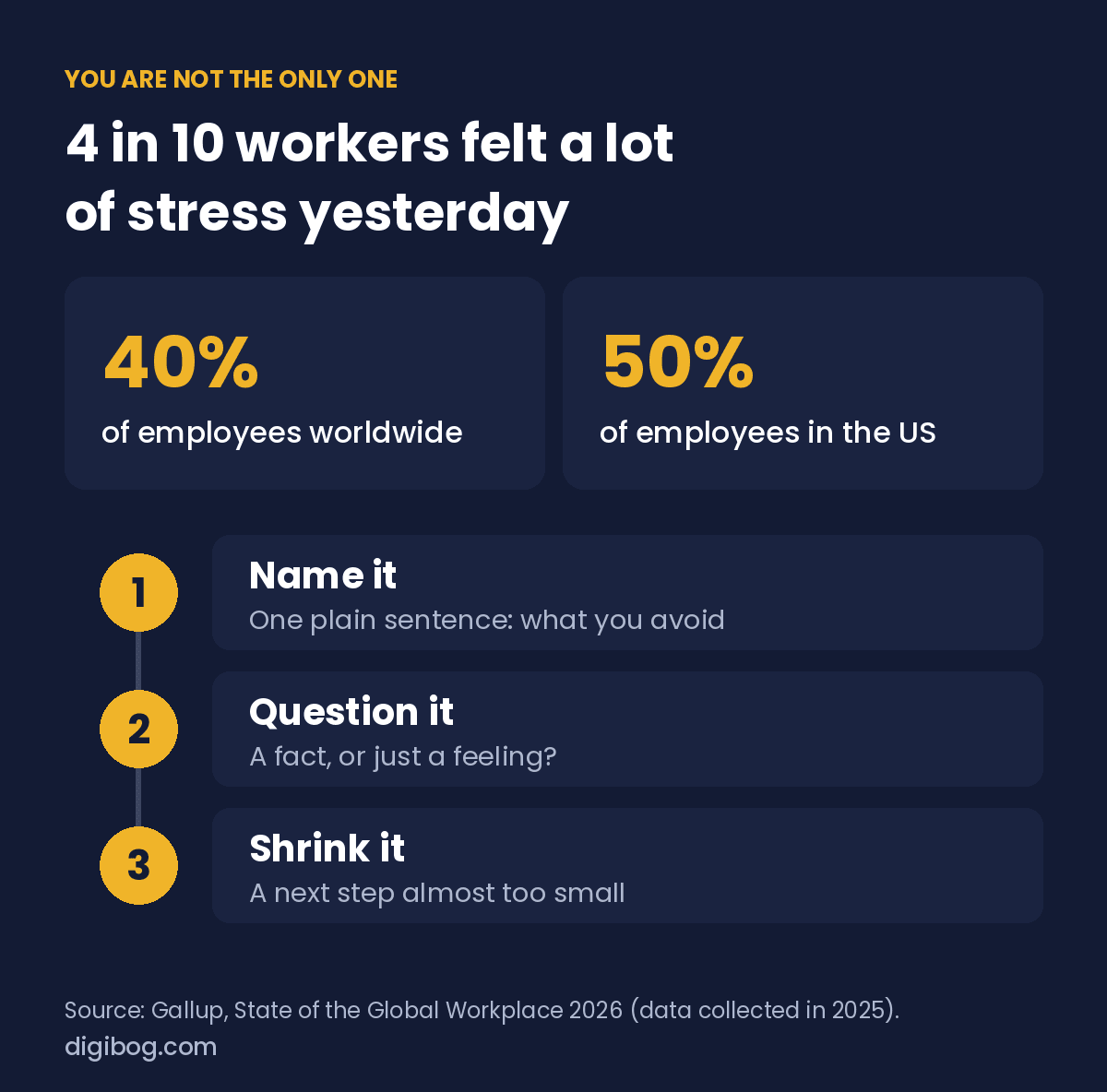
Far from alone is not a figure of speech. In Gallup’s latest global workplace survey, 40% of employees worldwide said they had experienced a lot of stress the previous day, and in the United States it was half. Overwhelm is one of the most common working states there is. What changes outcomes is what you do in the next five minutes, which is what the rest of this article is about.
Why you feel overwhelmed and stuck
Often the thing blocking you is not the task itself but the story around it: that you will probably mess it up, that you should be further along by now, that there is simply too much to do. Those thoughts create pressure, pressure creates avoidance, and avoidance feeds the next round of self-criticism. It is a loop, and willpower alone rarely breaks it.
The loop is sneaky because it feels like laziness from the inside. In reality it is your mind trying to protect you from a task it has decided is threatening. The way out is not to push harder against the wall, but to make the task feel smaller and safer.
It also helps to notice how often the overwhelm is really about volume, not difficulty. Ten medium tasks with no order can feel heavier than one genuinely hard one. When everything shouts for attention at once, the mind freezes rather than choosing, and that freeze is exactly what we experience as being stuck.
A gentler approach
What helps is slowing down enough to notice the thought, question whether it is actually true, and choose one small next step anyway. That simple practice, drawn from Cognitive Behavioral Therapy techniques, takes the charge out of the pressure and makes starting feel possible again. You do not have to believe a kinder thought instantly. You only have to loosen the grip of the harsh one enough to move.
Our CBT Therapy and Productivity Workbook walks you through exactly that, with thought-reframing pages, gentle goal-setting, and action steps that respect your energy. It is a self-guided tool, not a replacement for support from a licensed professional, but for everyday overwhelm it can be a steadying place to start. If you want to understand the method behind it, the American Psychological Association offers a clear overview of how these techniques work.
Three small steps to try right now
When the fog rolls in, you do not need a grand plan. You need one move. Try these in order, the same three shown in the graphic above. First, name it: write down, in one plain sentence, what you are actually avoiding, because naming a worry shrinks it. Second, question it: ask whether the scary story is a fact or just a feeling, and what you would tell a friend who said the same thing about themselves. Third, shrink it: pick a next step so small it feels almost silly, then do only that. Opening the document counts. Writing one line counts. Each tiny action is proof that the task is survivable, and that proof is what loosens the freeze.
A gentler structure for the weeks that are heavy
The CBT Therapy & Productivity Workbook is a fillable PDF pairing practical productivity tools with techniques inspired by Cognitive Behavioural Therapy. It is a self-guided workbook, not therapy and not a substitute for it.
See the workbookInstant download · unlimited downloads · no expiry · one payment, no subscriptionA short reset when it all feels like too much
In the moment, before any planning, try a ninety-second reset. Step away from the screen, take a few slow breaths, and let your shoulders drop. Then ask one question: what is the single most important thing, and what is the smallest piece of it I can touch right now? You are not trying to solve everything at once. You are trying to interrupt the spin long enough to take one honest step. Surprisingly often, that is all it takes for the wall to start feeling like a door.
Name what kind of stuck it is
Overwhelmed and stuck are two different states that feel identical from the inside. Treating one with the other’s cure is why nothing works.
| What it feels like | What it usually is | What helps |
|---|---|---|
| Too much to do, cannot pick | Volume. The list is genuinely too long. | Cut, do not sort. Delete or defer half before choosing. |
| Know the task, cannot start | The first step is undefined, so it is not really a task | Write the next physical action. “Open the file” counts. |
| Start, then drift | The task is bigger than one sitting and has no visible end | Set a stopping point, not a finishing point. Twenty minutes, then stop. |
| Avoiding one specific thing | Something unresolved sits inside it. A decision, a difficult message. | Do the uncomfortable part first, alone, in five minutes. |
| Busy all day, nothing moved | Reactive work crowded out the work that matters | One protected hour before the inbox opens. |
Most productivity advice assumes the first row. If your actual problem is the fourth, a better task list will not touch it.
Frequently asked questions
Why does my to-do list make things worse?
Because a list of everything is a record of debt, not a plan. Seeing forty items does not help you choose one. A short list for today, written separately from the long list, removes most of that weight.
Should I work on the hardest thing first?
Usually yes, but “hardest” often means “most unclear”. If a task resists being started, the useful move is defining its first step rather than summoning more willpower for it.
How do I stop reorganising instead of working?
Give the system a time budget. Ten minutes at the start of the week and five at the end of each day. Outside that window, the system is whatever it is and the work happens anyway.
What if everything genuinely is urgent?
It is not, but it can look that way when consequences are unclear. For each item, write what actually happens if it slips a week. Most lists shrink noticeably once that is on paper.
Does this apply if I have ADHD?
The general shape does, though the specifics differ. Externally visible time and much shorter feedback loops matter far more, which is covered in ADHD time blindness and how to make time visible.
Build on the calm
Once the pressure eases, a little structure keeps the momentum going. The Productivity with ADHD Workbook helps you turn a calmer mind into doable daily steps, and keeping your work in one place with the Small Business Hub Planner, a fillable PDF, removes the clutter that often fuels overwhelm in the first place. Small, repeatable systems mean you spend less energy deciding what to do and more on simply doing it, which keeps the overwhelm from creeping back.
Progress does not require being hard on yourself. Sometimes the most productive thing you can do when you feel overwhelmed and stuck is to be a little kinder, and take one small step. The goal is not to feel perfectly calm before you begin; it is to begin gently, and to let a steadier feeling follow the action rather than waiting for it to arrive first.
Related reading: Stop Juggling Apps: How to Run Your Whole Business From One Place.
If feelings of overwhelm ever become more than everyday stress, please consider reaching out to a qualified mental health professional.
About the author. Written by Said Sihame, founder of DigiBog. I make the planners, workbooks and checklists sold on this site, and these articles come out of the same work. I am not a clinician and nothing here is medical advice — this is an educational and organizational resource.