Social media gets the attention, but for many small businesses the sales come from somewhere quieter: email. The real story of email vs social media is simple. Followers are rented; an email list is owned.
Email marketing ROI vs social media, in numbers
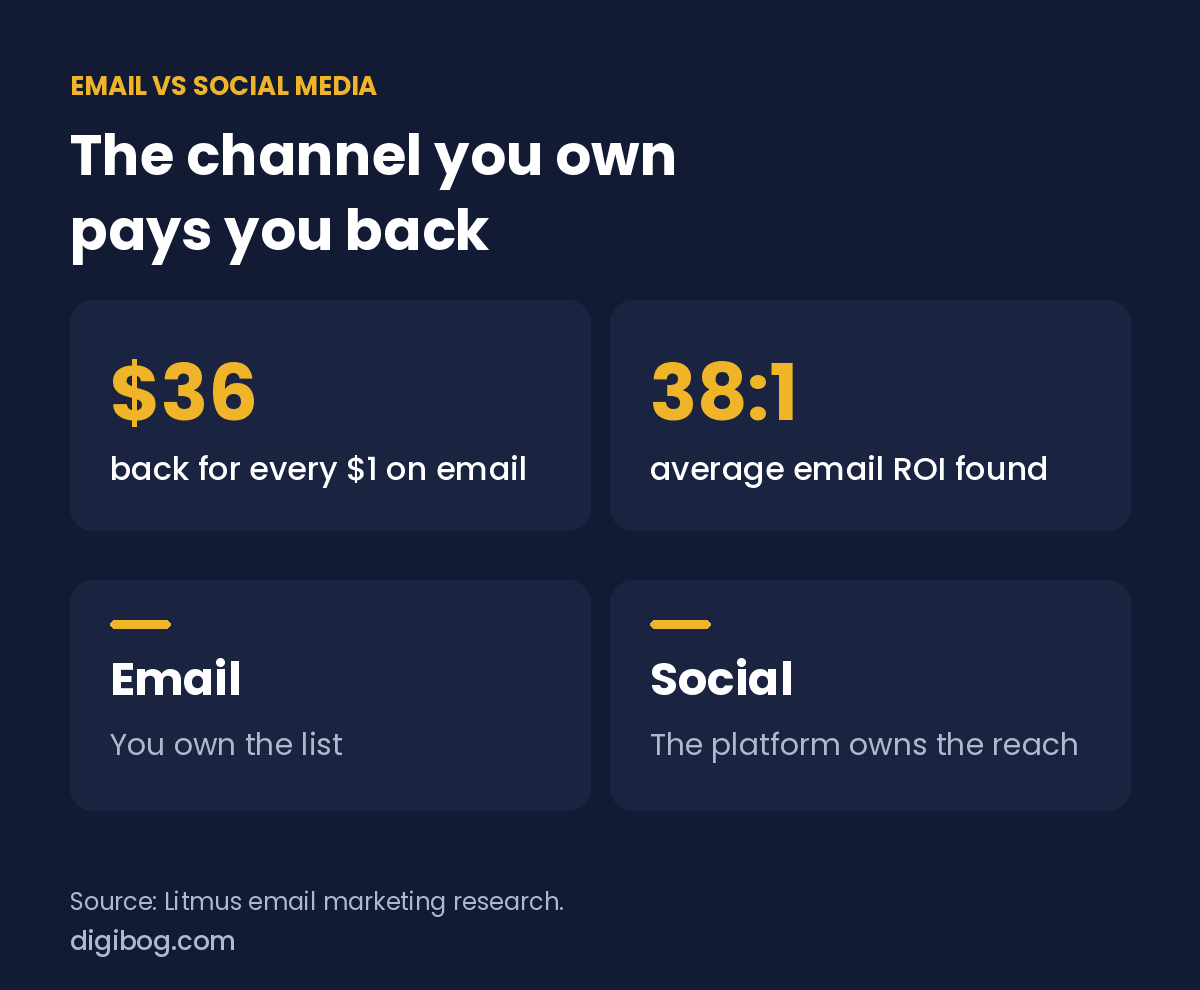
The strongest case for email is not opinion, it is return. Litmus research puts email marketing ROI at around $36 to $38 back for every $1 spent, depending on the year of the study. Social media has no single equivalent figure, because its return varies so widely by platform, audience and how much you pay for reach. That difference is the point: one channel you own and can measure, the other you rent.
Email vs social media: the reach you control
When you post on Instagram or TikTok, an algorithm decides how many of your followers ever see it, and it is often a small fraction of the people who chose to follow you. Email is different. When you send a message, it goes to everyone who chose to hear from you, minus whatever spam filters catch. No gatekeeper deciding your reach, and no paying to reach an audience you already built.
This is the heart of the email vs social media debate. Social platforms own the relationship with your audience. Email gives that relationship back to you, and that ownership is a large part of why the return figures above look the way they do.
There is also the question of permanence. A viral post is exciting for a day and then it is gone, buried under the next wave of content. An email list keeps working quietly in the background. Send a message today, next month or next year, and the people on it are still there, still reachable, still yours.
Email against social, side by side
| Social media | ||
|---|---|---|
| Who owns the audience | You. The list is a file you can export. | The platform. Access can change overnight. |
| Who sees it | Everyone you send to, minus what spam filters catch | Whoever the algorithm decides, usually a fraction |
| Intent | They gave you an address on purpose | They were scrolling. Your post interrupted something. |
| Lifespan of a message | Sits in an inbox until acted on | Hours, sometimes minutes |
| Reported return | About $36 to $38 per $1 spent (Litmus) | Varies widely by platform |
| What it is good at | Turning people who know you into buyers | Being found by people who do not |
The last row is the honest summary. Social is a discovery channel. Email is a conversion channel. Judging one by the other’s job is how people conclude that either is dead.
Why most newsletters die in a month
The return only arrives if the emails actually go out, and that is where most owners stumble. The problem is rarely the idea. It is the lack of a plan. Most owners send a few enthusiastic emails, run out of things to say, and quietly stop. Consistency beats brilliance, and consistency comes from planning ahead instead of writing from scratch every week.
It usually goes like this: week one is exciting, week two is a scramble, and by week three the newsletter is forgotten. The fix is not more motivation. It is a calendar that already knows what you are sending, so showing up takes minutes instead of an afternoon staring at a blank screen.
That is the gap our Email Marketing 30-Day Planner is built to close. It gives you a full month mapped out in one sitting, with a subject-line tracker, sequence planner and a content idea bank so you never face a blank screen.
What to send when you have nothing to say
The blank-screen panic usually comes from believing every email has to be brilliant. It does not. Readers want useful and human far more than polished. Share one lesson you learned this week. Answer a question a customer actually asked. Tell the short story behind why you built what you sell. Point to something you found helpful and explain why it matters. Offer a small tip they can use in two minutes. None of these need a marketing degree, and all of them keep you in front of your audience. A simple content idea bank turns this from a weekly scramble into a quick choice from a list you already made.
Plan a month of email in one sitting
The Email Marketing 30-Day Planner includes a subject-line tracker and a sequence planner in a fillable PDF — for the part most people skip, which is deciding what the emails actually say.
See the plannerInstant download · unlimited downloads · no expiry · one payment, no subscriptionHow to start growing a list today
You do not need thousands of subscribers to see results. Start by giving people one clear reason to join, such as a useful freebie, a discount or early access, and put that offer everywhere your audience already is. Add a simple sign-up form to your site, mention it in your social posts, and tell people exactly what they will get and how often. Then send a short welcome email right away so the relationship begins while you are fresh in their mind. Small and consistent wins here. A list of two hundred engaged readers who open and trust your emails is worth far more than ten thousand followers who never see your posts.
Frequently asked questions
How often should I email my list?
Often enough that they remember signing up. For most small businesses that is somewhere between weekly and monthly. Consistency matters more than frequency: a predictable monthly email outperforms a burst of six followed by four months of silence.
What if my list is tiny?
A hundred people who chose to hear from you is a better asset than a thousand followers who did not. Small lists also let you write like a person rather than a brand, which is exactly the advantage email has.
Will people unsubscribe if I sell?
Some will, and that is fine. A list that never gets an offer is not a business asset, it is a newsletter. The people who leave when you sell were never going to buy.
Should I move people from social to email?
Yes, constantly. That is the main commercial job of a social account. Give people a specific reason to hand over an address, not a generic invitation to subscribe.
What should my first email be?
Deliver whatever they signed up for, immediately, and tell them what to expect next and how often. That single message sets the expectation that decides whether the next twenty get opened.
Email and social work better together
This is not about abandoning social media. Your posts are how new people discover you; email is how you turn them into customers. The smartest approach is to use social content to grow the list, then let email do the selling. Think of social as the front door and email as the conversation that happens once someone walks in. That pairing matters most around a digital product launch, when you need both new eyes and people ready to buy.
If you want your social posts working on a plan too, start with a 30-day social media content plan, and our Social Media 30-Day Content Planner pairs naturally with the email planner so both channels run on a system instead of panic. If you would rather set up your whole marketing toolkit at once, the Business Starter Bundle brings the essentials together.
Followers feel good. A growing email list pays the bills. When you weigh email vs social media for the long run, build the audience you actually own.
About the author. Written by Said Sihame, founder of DigiBog. I make the planners, workbooks and checklists sold on this site, and these articles come out of the same work. Everything here is what I use and test myself — take what fits and leave the rest.