If you have ever written a to-do list, felt great about it, and then ignored it completely by lunchtime, you are not lazy and you are not broken. The standard to-do list was simply never designed for a brain that moves fast and jumps between ideas. An ADHD to-do list needs a different design, and the changes are small.
You are also in large company. The CDC estimates that about 1 in 16 US adults, 15.5 million people, currently have an ADHD diagnosis, and more than half of them were diagnosed as adults. Most were handed a list format built for a different brain long before they knew why it never worked for them.

Why the classic to-do list fails
A flat list of tasks treats every item as equal. Your brain does not. Some tasks feel exciting, some feel impossible to start, and the list gives you no help telling them apart. Worse, a long list quietly grows into a monument of guilt. Each unfinished item adds pressure, and pressure is the enemy of starting.
For entrepreneurs who think this way, the problem is rarely effort. It is friction: too many choices, no clear entry point, and no reward for momentum. A classic list also ignores energy. It asks you to do the same kind of work whether you are sharp in the morning or fading in the afternoon, then makes you feel guilty when the later tasks never get done.
Then there is time blindness. A plain list shows what to do but never how long anything will take, so a quick win and a half-day project sit side by side looking identical. You pick one almost at random, lose track of time, and the rest of the list silently rolls over to tomorrow.
What an ADHD to-do list actually needs
- Capture, then sort. Give racing thoughts a place to land with a quick brain dump, then decide what actually matters today.
- Limit the daily list. Choose three real priorities instead of twenty. A short list you finish beats a long one you abandon.
- Chunk the work. Break big projects into the smallest next step. “Launch the store” is paralyzing. “Write one product title” is doable.
- Plan around energy, not the clock. Match hard tasks to your high-focus hours instead of forcing a rigid schedule.
- Reward momentum. Build in small wins so starting feels good, not just finishing.
None of this is about trying harder. It is about removing the friction a plain list creates. Advocacy organizations such as CHADD have written for years about how structure and outside systems help ADHD brains far more than willpower does.
A simple ADHD to-do list method to try today
Those principles fit into a four-step ritual you can try this morning.
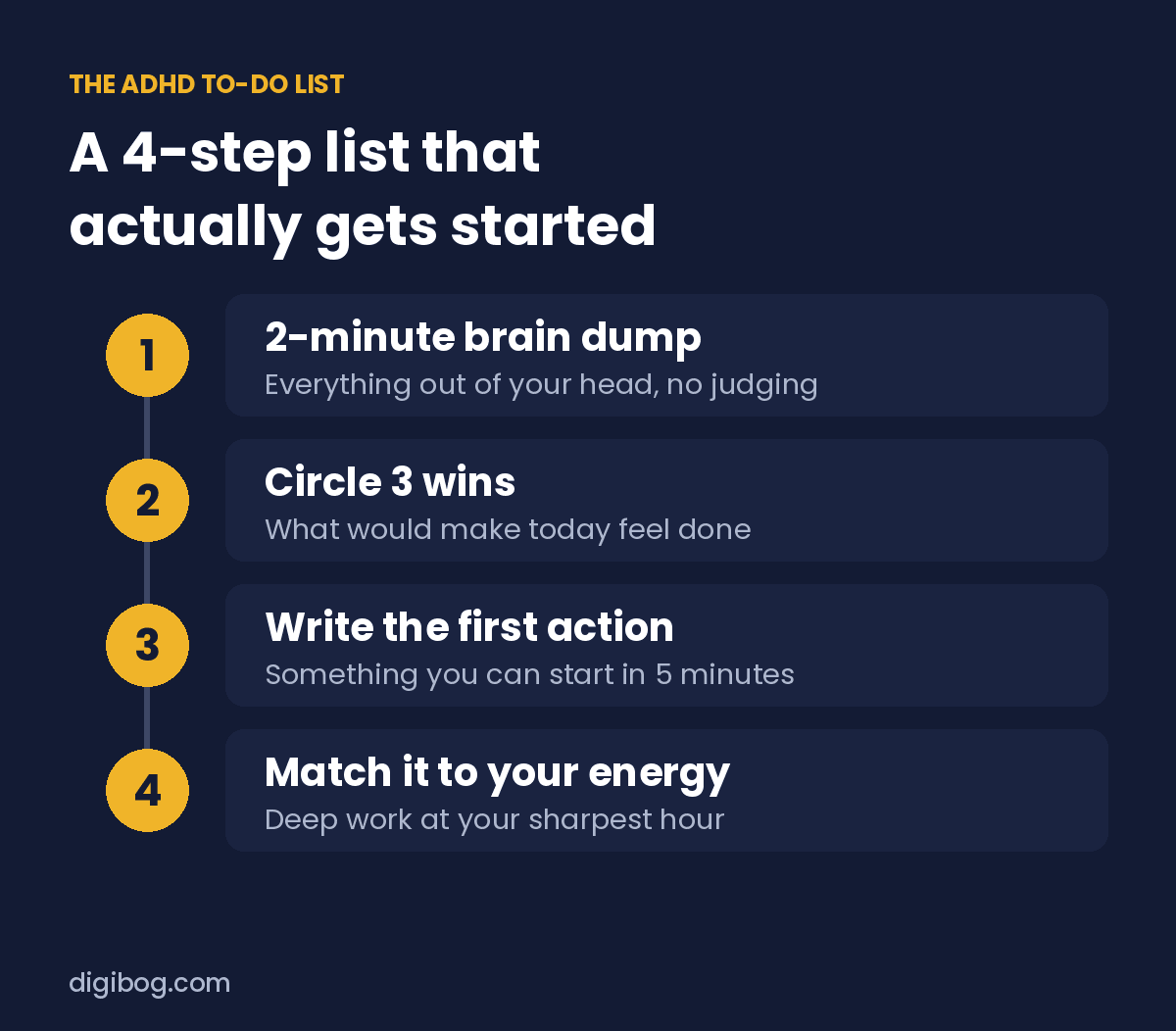
- Two-minute brain dump. Write down everything bouncing around your head, without judging it.
- Circle three wins. The three items that would make today feel done.
- Write the first action. For each of the three, the very first physical step, something you could start in under five minutes.
- Match it to your energy. Deep-focus work for your sharpest hours, light admin for the slumps.
This small ritual does what a plain list never could. It clears the mental clutter, narrows your focus to what matters, and gives your brain an obvious, low-resistance place to begin. It is the same thinking behind our Productivity with ADHD Workbook, which replaces the endless list with task chunking, energy-based time blocking, and a dopamine menu to help you start.
Classic to-do list vs ADHD to-do list
The difference is not discipline, it is design. Here is what changes, side by side.
| Classic to-do list | ADHD to-do list |
|---|---|
| Every task, all at once | Three wins for today |
| “Do taxes” | “Open the tax folder” |
| Ordered by importance | Matched to energy |
| Unfinished items roll over forever | Brain dump fresh each morning |
| One list for everything | Capture list plus today list |
If the list keeps failing because the habit never sticks, read why streaks fail with ADHD.
Twenty-four checks for a list that holds
Productivity with ADHD — Checklist is a 4-page fillable PDF with 24 practical checks for an ADHD-friendly system. Run it against the list you already have before you build another one.
See the checklistInstant download · unlimited downloads · no expiry · one payment, no subscriptionWhat to do on a low-focus day
Some days the focus simply is not there, and fighting it only adds guilt. On those days, shrink the bar instead of forcing the usual workload. Keep one win instead of three, pick a tiny, low-stakes task that takes five minutes, and let that be enough. Tidy your inbox, schedule one post, or reply to a single client. Protecting your relationship with your own system matters more than any single day of output, because a system you still trust tomorrow is worth far more than a heroic day that burns you out. Consistency, not intensity, is what adds up over a year.
Frequently asked questions
Why do I abandon my to-do list by lunchtime?
Because a flat list treats every task as equal and gives your brain no obvious place to start. A long list also turns into a record of everything you have not done, and that pressure makes starting harder.
How many tasks should an ADHD to-do list have?
Three wins for the day. The brain dump can hold everything else, but the list you work from should be short enough to finish. A short list you complete beats a long one you abandon.
Should I use paper or an app?
Whichever you will actually open every day, and only one of them. If you want an app, the best ADHD productivity tools are sorted by the job they do, so you can pick just one.
What if I do not finish my three wins?
Carry them to tomorrow and shrink the first action. If one keeps rolling over, it is usually too big or too vague to start, not a sign that you failed.
Is this only for people diagnosed with ADHD?
No. The method helps anyone who finds plain lists hard to start, whether or not they have a diagnosis. It is an organizational approach, not medical advice.
Make it stick with the right systems
A to-do list handles your day, but your business also needs a home for everything else. Keeping clients, content and finances in one place cuts the mental switching that drains focus, which is why many readers pair their list with our Small Business Hub Planner, a fillable PDF planner for exactly that.
If you are just getting started and want the essentials in one go, the Business Starter Bundle is the simplest way to set up a solid foundation without piecing together a dozen tools. And if you want an app to carry part of the load, start with the best ADHD productivity tools, and how to pick just one.
You do not need more willpower. You need a system that fits the way you actually think, and an ADHD to-do list that works with your brain instead of against it. Start small, protect your energy, and let momentum do the rest.
Related reading: Overwhelmed and Stuck? A Calmer Way to Finally Get Things Done.
This is an educational and organizational resource, not medical advice.
About the author. Written by Said Sihame, founder of DigiBog. I make the planners, workbooks and checklists sold on this site, and these articles come out of the same work. I am not a clinician and nothing here is medical advice — this is an educational and organizational resource.