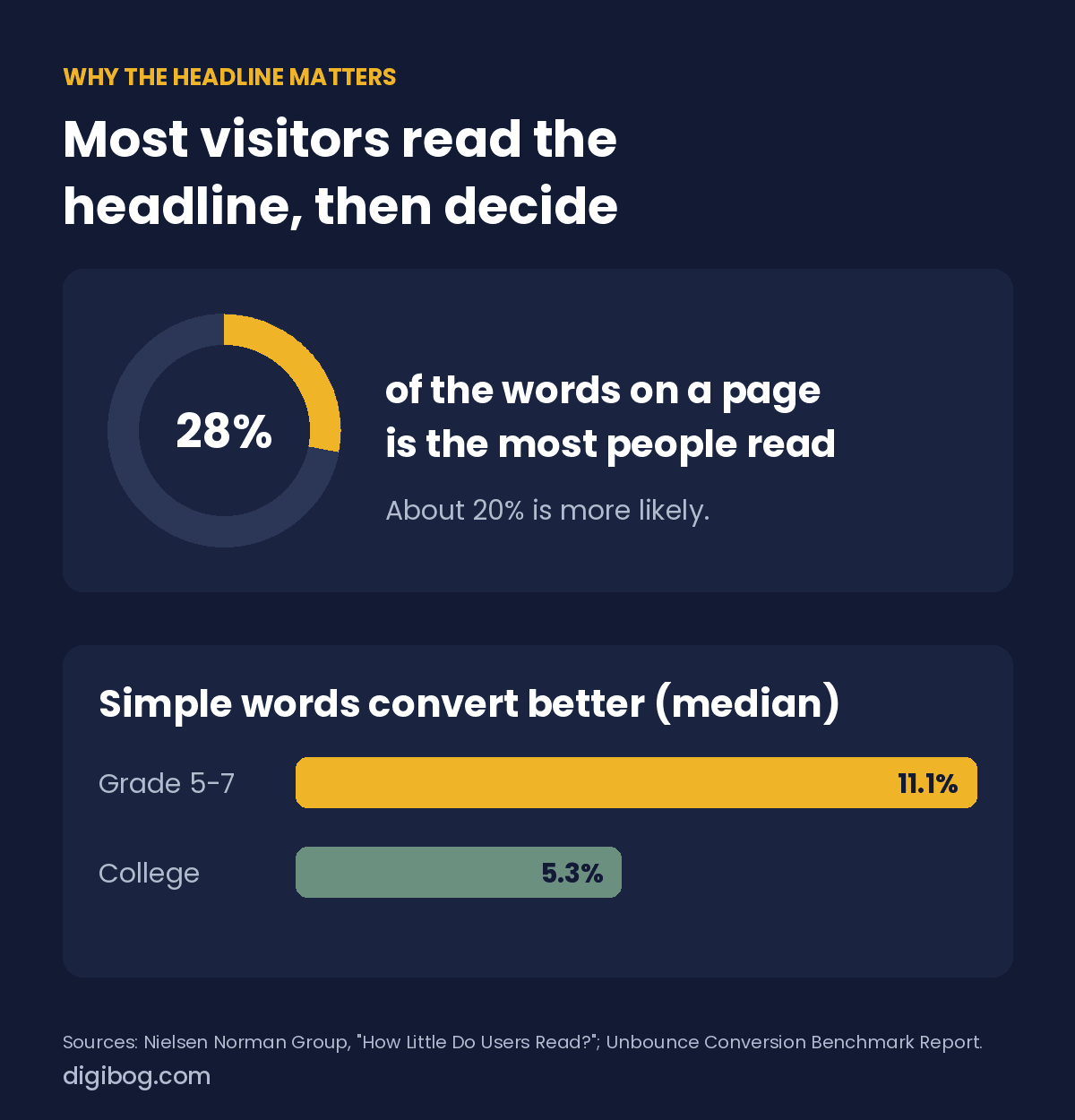
The headline is the only line most visitors will read carefully. Everything after it is optional. Nielsen Norman Group research found that people read at most 28% of the words on a typical web page, and about 20% is more likely. So the difference between a page that works and a page that does not is often one sentence, written in about ninety seconds and never looked at again. A landing page headline has exactly one job: earn the next line.
What a headline is actually for
Not to sell. Not to be clever. Its single job is to earn the next line.
That reframing changes what a good headline looks like. You are not compressing your entire offer into ten words. You are giving someone one reason to keep going. Once you stop trying to close the sale in the first sentence, headlines get easier to write and better at their job.
Plain beats clever in the numbers too. In Unbounce’s benchmark, pages written at a grade 5 to 7 reading level converted at 11.1%, against 5.3% for pages written at a college level. Simple words are not a compromise. They are what converts.
The four ingredients of a landing page headline
Strong headlines tend to contain some combination of these. Not all four, usually two.
- Clarity. A stranger can tell what this is. This is non-negotiable; the rest are optional.
- Specificity. “In one afternoon” beats “quickly.” Concrete beats vague every time.
- Relevance. It names the reader’s situation, not your product category.
- Tension. A gap between where they are and where they could be, without overpromising.
Formulas worth stealing
Formulas are scaffolding, not a finished building. Use one to get a draft out, then rewrite it in your own voice.
- Outcome without obstacle — Get X without Y. Works when a known frustration blocks the goal.
- How to, for a specific person — How freelancers can X. Narrow beats broad.
- The uncomfortable question — Still doing X by hand? Only if the answer is genuinely yes for your reader.
- Named result with a timeframe — X in an afternoon. Only if it is true.
- The correction — Everything you were told about X. Powerful and easy to overuse.
The test that catches weak headlines
Read your headline and ask: could a competitor put their name on this without changing a word?
If yes, it is not a headline. It is a category description. “Professional web design services” belongs to everyone, so it belongs to no one.
The second test: does it say something a reasonable person might disagree with? Headlines nobody could argue with are usually headlines nobody remembers.
Write ten, keep one
The most reliable technique is also the least exciting. Write ten headlines in one sitting. The first three will be obvious, the middle four will be worse, and something usable usually appears around eight or nine, once you have exhausted the easy options.
Do not edit while writing. Get all ten down, then choose.
Five headlines, rewritten
The fastest way to develop judgement here is to read weak and strong versions of the same offer side by side.
| Weak | Stronger | What changed |
|---|---|---|
| Welcome to our accounting service | Your books, closed by the 5th, every month | Names an outcome and a deadline instead of a category |
| The best project management tool | See every deadline your team is about to miss | Replaces a claim nobody believes with a specific fear |
| Learn photography online | Take photos your friends assume you paid for | Swaps the activity for the reason anyone wants it |
| Premium organic dog food | The food fussy dogs actually finish | Points at the problem the buyer already has |
| Transform your business today | Cut your invoicing admin from 6 hours to 40 minutes | Trades a verb nobody can picture for two numbers |
Notice that none of the stronger versions are clever. They are specific and plainly worded. Cleverness is what people reach for when they cannot think of anything concrete to say, and readers can tell.
Four traps that look like good headlines
| Trap | Example | Why it fails |
|---|---|---|
| The company introduction | “Welcome to Acme Solutions” | Uses the most valuable line on the page to say something the visitor can already see. |
| The unprovable superlative | “The world’s best CRM” | Every competitor says it, so it carries no information. Readers discount it automatically. |
| The pun | “Let’s taco ’bout your taxes” | Costs a second of comprehension to earn a small smile. The reader spends the second and leaves. |
| The abstraction | “Empowering teams to reach their potential” | Could describe a gym, a school or a software company. Fits everything, means nothing. |
All four fail the same way: they spend the most-read line on the page saying nothing the reader can use.
The headline is the first line. This is the rest of the page.
The Landing Page Persuasion Guide is an 8-page reference plus a 9-page fillable workbook on the words, the order and the psychology that carry a reader from the headline to the button.
See what is insideInstant download · unlimited downloads · no expiry · one payment, no subscriptionThe subheading does the second half
A short, punchy headline often leaves something unsaid. That is what the line underneath is for. Headline earns attention, subheading earns the scroll, so judging a headline alone, without the line under it, gives you a false read.
A common failure is writing two headlines and stacking them. The reader gets two claims and no progression, so the second does no work. The pair should split the job: the headline names the outcome or the problem, and the subheading answers the first question that raises: how, for whom, or how fast.
| Headline | Subheading that works |
|---|---|
| Your books, closed by the 5th, every month | Fixed monthly fee. We do the chasing, you approve. For UK businesses turning over £200k to £2m. |
| Take photos your friends assume you paid for | Six weeks, one lesson a week, using the camera you already own. |
| See every deadline your team is about to miss | Connects to the tools you already use. Two-minute setup, no migration. |
Each subheading answers a different doubt: who it is for, what it asks of them, and how hard it is to start. Pick the one your reader would raise first, not the one you most want to say.
How to write effective landing page headlines: a 5-point check
Run every landing page headline through these five questions before it goes live. A headline that fails two of them will usually lose the visitor before the second line, however good the rest of the page is. The plain-words row is the grade 5 to 7 level that converted best in the benchmark above.
| Check | Pass looks like | Fail looks like |
|---|---|---|
| Outcome | Says what the reader gets | Says what the product is |
| Reader | A specific person can recognise themselves | Written for “everyone” |
| Plain words | A 12-year-old understands it | Jargon or buzzwords |
| Match | Repeats the promise of the ad or link | Changes the subject after the click |
| Next line | Makes you want the subheading | Says everything, leaves nothing to read |
When the headline is fine and the page still fails
A strong headline buys you the next line, not the sale. If people read past the first screen and still leave, the problem has moved further down the page, usually to an unanswered objection or a call to action that asks for more than the page has earned. Those are covered in the four objections killing your landing page, how to write a call to action people actually click and why your landing page gets traffic but no conversions.
Also check that the headline matches what brought them. Someone who clicked an ad promising a free template and lands on a headline about a paid audit will leave however well written the line is. The mismatch is the problem, not the copy.
Frequently asked questions
How long should a landing page headline be?
Short enough to read in one glance, which in practice is around six to twelve words. Length matters less than whether it can be understood without a second pass. If you need a comma and a subclause, some of it belongs in the subheading.
Should the headline mention the product name?
Usually not. The name means nothing to someone who has not bought yet, and it consumes space that could describe an outcome. Put the name in the logo and the button, and give the headline to the reader’s problem.
Do questions work as headlines?
Sometimes, if the answer is obviously yes and the question names a real frustration. “Still chasing invoices by hand?” works. “Want to grow your business?” does not, because it is so broad that answering it costs the reader nothing.
How many headlines should I write before choosing?
Ten is a good discipline. The first three are the obvious ones, four to seven are where you start reaching for specifics, and the last few are usually where something unexpected appears. Writing two and picking the better one is how mediocre headlines survive.
Should the headline match my ad exactly?
Close enough that the visitor recognises it instantly. Identical wording is safest, and a close paraphrase is fine. What kills conversion is a headline that raises a different subject from the one they clicked on.
Try this now
Take your current headline. Write ten alternatives using the formulas above. Then show the best three to someone who does not know your business, and ask what they think you sell. If they get it wrong, the headline is wrong, not the reader.
The Landing Page Persuasion workbook walks through headline analysis and rewriting as fillable exercises, and the 25 AI prompts speed up the drafting when you are staring at a blank page.
All six pieces — book, workbook, guide, prompts, toolstack and checklist — come together in the Landing Page Persuasion Complete Bundle.
About the author. Written by Said Sihame, founder of DigiBog. I make the planners, workbooks and checklists sold on this site, and these articles come out of the same work. Everything here is what I use and test myself — take what fits and leave the rest.