You built something great. Then launch week arrives and suddenly you are writing emails at midnight, scrambling for graphics, and wondering why nobody seems to be buying. A weak launch can sink a strong product, and learning how to launch a digital product without the chaos almost always comes down to one thing: a plan.
Why good products have quiet launches
Most first launches do not fail because the product is bad. They fail because everything was left to the final days. Without a runway, there is no anticipation, no warm audience, and no momentum when you finally hit publish. Launching cold to silence is discouraging, and completely avoidable.
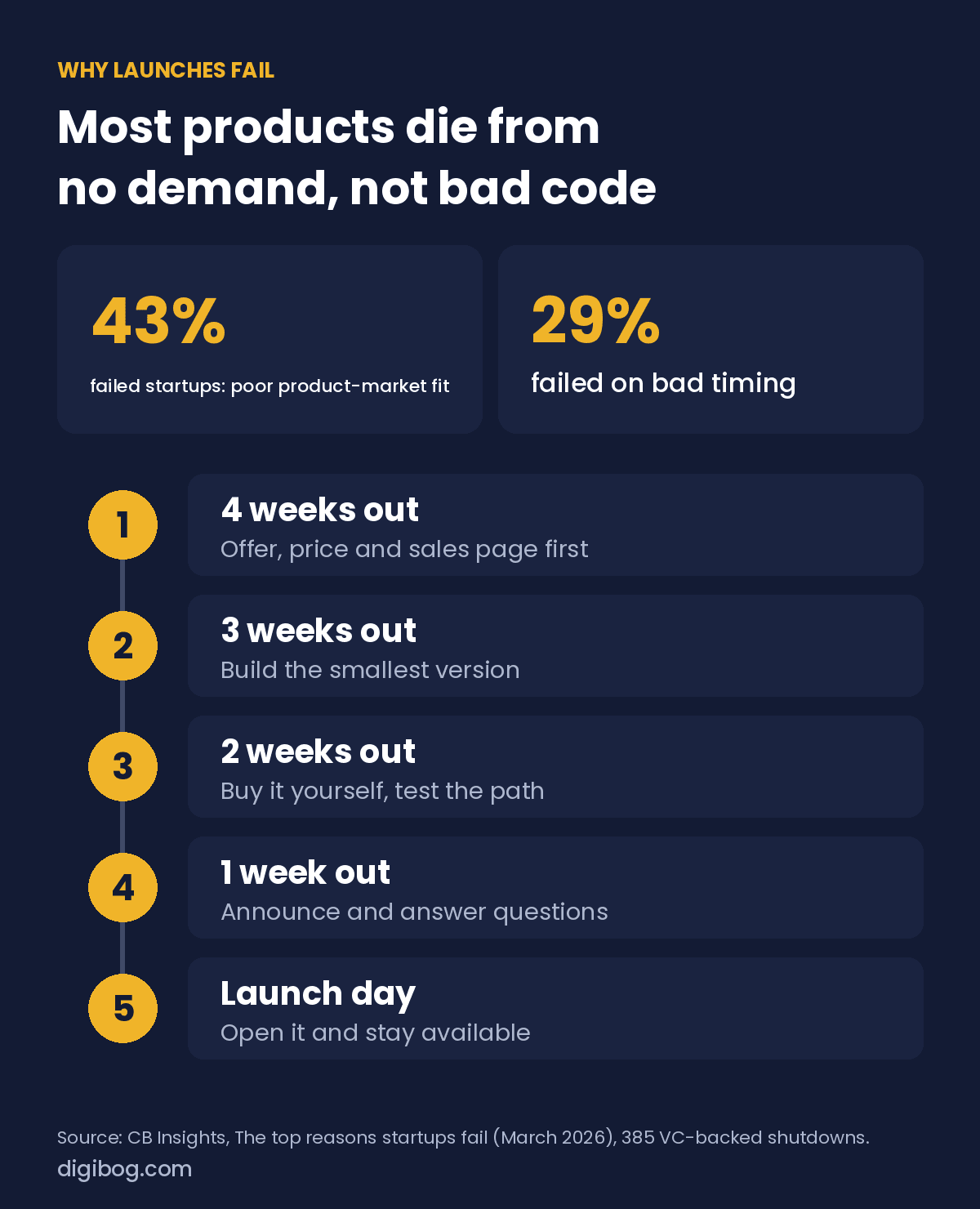
The trap is that building the product feels like the hard part, so the launch becomes an afterthought. The bigger risk sits even earlier. When CB Insights studied VC-backed startups that shut down since 2023, the most common deeper cause was poor product-market fit, cited in 43% of cases, with bad timing in 29%. Those are funded startups, not solo product sellers, but the pattern holds at any size: people rarely fail for lack of effort, and often for lack of proof that anyone wanted the thing. A good launch plan checks for that first.
How to launch a digital product without the chaos
A good launch starts weeks before the doors open. You build anticipation, you warm up your audience, and you line up every email and post in advance so launch week is calm execution instead of panic. In practice, knowing how to launch a digital product means having four things ready early:
- A pre-launch checklist so nothing important is forgotten
- A content calendar that builds interest in the weeks before
- A clear offer and price you feel confident about
- A launch-week email and social sequence written ahead of time
Our Digital Product Launch Planner maps all of that out for you, from idea to launch day to a post-launch review, so nothing slips through the cracks.
Avoid the most common launch mistakes
Three mistakes sink more launches than anything else. The first is launching to a cold audience, with no warm-up and no list to tell. The second is a fuzzy offer, where people cannot quite tell what they get or why it is worth the price. The third is going silent right after launch day, when a single thoughtful follow-up could have caught the buyers who simply needed one more nudge. A plan written in advance quietly prevents all three, because the decisions are already made before the pressure hits.
The roadmap from idea to launch day
The Digital Product Launch Planner is a step-by-step fillable PDF with a pre-launch checklist, a content calendar and pricing pages — so launch week is execution rather than improvisation.
See the plannerInstant download · unlimited downloads · no expiry · one payment, no subscriptionFuel the launch with content
A plan is only as strong as the messages behind it. The Email Marketing 30-Day Planner helps you write the sequence that does the actual selling, while the Social Media 30-Day Content Planner keeps your feed building anticipation in the weeks before you go live. When the doors finally open, put your product in front of people actively looking for new tools; launch communities like Product Hunt can add a wave of early attention to a well-prepared launch.
What to do after launch day
The launch is not over when the doors open. The hours and days right after are where many sales are actually won. Send a clear thank-you to early buyers, follow up once with anyone who showed interest but did not purchase, and pay attention to the questions people ask, since those reveal exactly what your sales page should say next time. Finally, write down what worked and what you would change while it is fresh. Every launch you review makes the next one calmer and stronger.
A four-week launch timeline
Most last-minute chaos comes from doing the sequence backwards: building everything, then thinking about how to sell it. Run two tracks side by side instead, one for what you build and one for what you tell people.
| When | Build | Tell | Done when |
|---|---|---|---|
| 4 weeks out | Decide the offer and the price. Write the sales page first. | Start talking about the problem your product solves. Collect emails. | You can describe it in one sentence someone else understands. |
| 3 weeks out | Build the smallest version that delivers the promise. | Share behind-the-scenes progress. | A real person could use it without you explaining anything. |
| 2 weeks out | Test the whole purchase path with your own money. | Open a waitlist for the keenest buyers. | You bought it yourself and received it correctly. |
| 1 week out | Fix what the test turned up. | Announce it directly. Answer questions publicly. | At least three people have asked something. |
| Launch day | Open it. Do nothing else that day. | Announcement, then a reminder and a last call over the following days. | You are available to fix what breaks. |
Writing the sales page in week four is the part people skip. If the page is hard to write, the offer is unclear, and finding that out before you build is worth a month. It is also the cheapest product-market fit test you will ever run.
Frequently asked questions
How finished does a product need to be at launch?
It has to deliver what the sales page promised. Nothing more. Extra modules and bonus material can be added while people are already using it, and the feedback will tell you which ones are worth building.
What if nobody buys on launch day?
Then you have learned something for the price of a quiet day. Check the sequence: did people know it was coming, was the offer clear, was the price the objection or the description. A silent launch is data, not a verdict.
Should I discount for launch?
A launch price is reasonable if it is genuinely temporary and you honour the deadline. Permanent discounts train people to wait, and a product that is always on sale reads as a product nobody paid full price for.
How do I test the purchase path?
Buy it yourself with a real card, on a phone, from a browser you are not logged into. Check the receipt, the download, and what happens if the download link is clicked twice. Most launch failures are plumbing, not marketing.
When should I start telling people?
Earlier than feels comfortable. Start talking about the problem around four weeks out, then make the direct announcement in the final week. Visible anticipation outperforms a surprise announcement, because it gives people time to decide rather than asking them to decide in the moment.
Price with confidence
A surprising number of launches stumble on price. Set it too low and buyers quietly question the value; set it without a reason and you hesitate every time someone asks. Decide your number early, write one clear sentence on why it is fair, and then hold it. When you believe the price is right, you stop apologizing for it, and that quiet certainty does more selling than any discount.
Great products deserve great launches. Give yours the runway it needs, and let launch day feel like a celebration instead of a scramble.
Related reading: How to Start Selling Digital Products on Etsy Without Guesswork and How to Turn Your Knowledge Into Your First Online Course.
About the author. Written by Said Sihame, founder of DigiBog. I make the planners, workbooks and checklists sold on this site, and these articles come out of the same work. Everything here is what I use and test myself — take what fits and leave the rest.