If you’re a small business owner, solopreneur, or freelancer, social media probably feels like a second job — one you didn’t sign up for. You know you need to post consistently, but between running your business, serving clients, and actually having a life, it rarely makes it to the top of the to-do list. The result? Sporadic posts, long silent stretches, and a nagging guilt every time you scroll past a competitor who seems to have it all figured out. Here is how to plan a month of social media in a single sitting.
Here’s the truth: social media consistency isn’t about posting every day — it’s about having a plan. Most small business owners treat social media like an open tab they’ll get to eventually. That’s why it never gets done. But what if you could close that tab permanently by dedicating just one focused hour per month? No scrambling for ideas, no staring at a blank caption box at 8 p.m., no missed weeks.
This post walks you through a simple one-hour monthly planning session that gives you a full 30 days of content direction — without burning out, hiring a social media manager, or spending money on complicated tools. Let’s get into it.
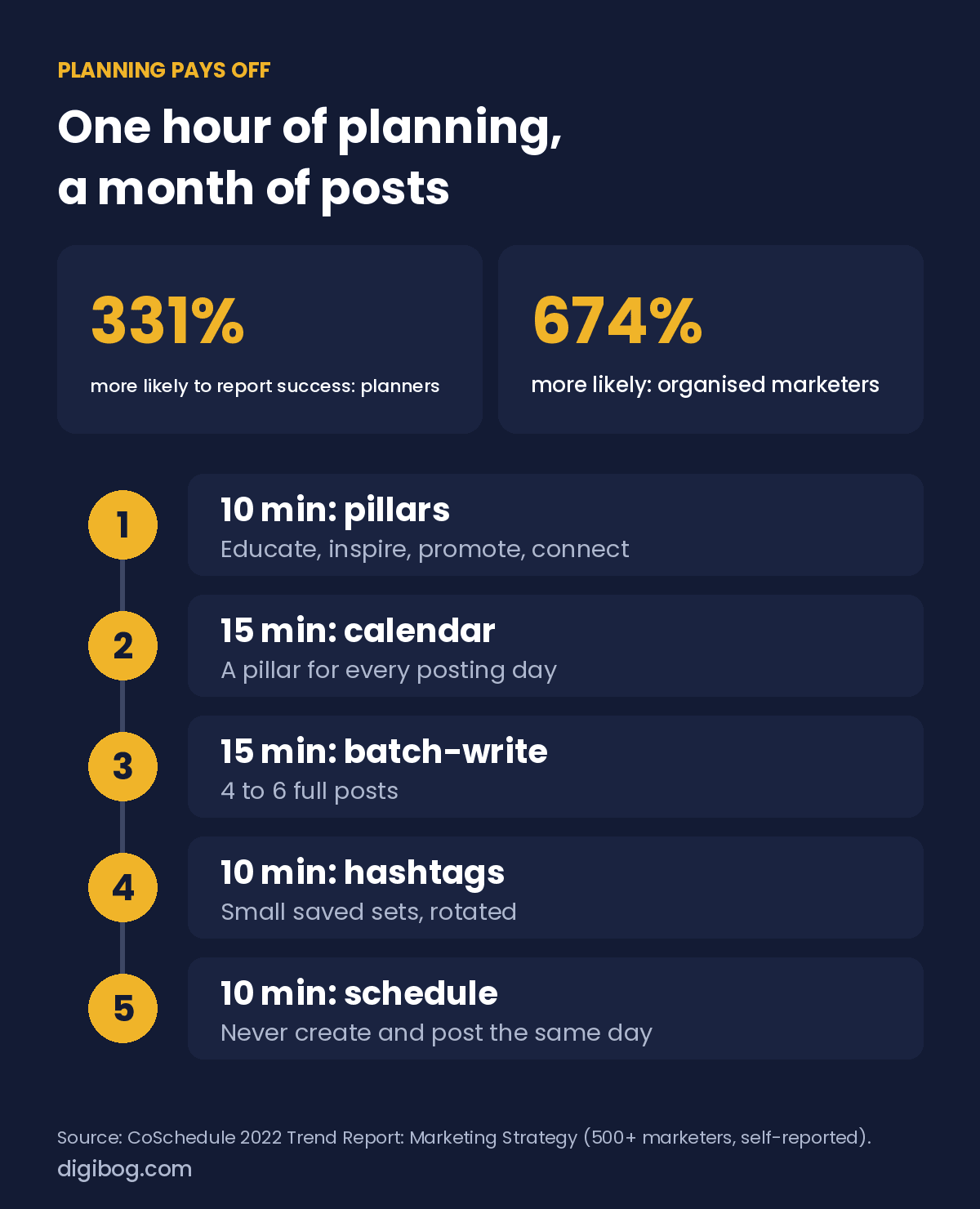
Planning is not just tidier; it tracks with results. In CoSchedule’s 2022 survey of more than 500 marketers, those who planned their marketing in advance were 331% more likely to report success, and organised marketers were 674% more likely. The figures are self-reported, but a gap that size is hard to ignore.
Why Most People Fail at Social Media Consistency
Before building a better system, it helps to understand why the current approach isn’t working. For most small business owners, the problem comes down to three things:
- No plan. When you don’t know what you’re posting tomorrow, you don’t post at all. Spontaneous content creation feels creative in theory but collapses under daily pressure. A blank calendar is the enemy of consistency.
- No time. Trying to create, write, design, and post content on the same day is exhausting. It turns every post into a mini-project instead of a routine task. The fix isn’t more time — it’s better batching.
- No system. Winging it works for a week, maybe two. But without a repeatable structure, social media stays at the bottom of the list indefinitely. Systems remove decision fatigue and make consistency the default, not the exception.
The good news: all three problems are solved by one thing — a monthly planning session. Here’s exactly how to run it.
The 1-Hour Session: How to Plan a Month of Social Media
Set a timer. Block your calendar. Make a coffee. This is the one hour per month that handles your entire social media strategy. Here’s how to spend it.
Step 1 (10 Minutes): Pick Your Content Pillars
Content pillars are the categories your posts fall into. They keep your feed purposeful and varied without requiring you to reinvent the wheel each time. For most small businesses, four pillars cover everything you need:
- Educate — Tips, how-tos, industry insights, and answers to common customer questions.
- Inspire — Behind-the-scenes moments, your story, client wins, or motivational content related to your niche.
- Promote — Products, services, offers, testimonials, and direct calls to action.
- Connect — Polls, questions, relatable humor, or personal updates that invite conversation.
Spend 10 minutes confirming these four pillars apply to your business and noting two or three specific topic ideas under each. This becomes your content menu for the month.
Step 2 (15 Minutes): Fill Your 30-Day Calendar with Content Types
Open a simple calendar — paper, spreadsheet, or a digital planner — and assign a content pillar to each posting day. You don’t need to write captions yet. Just decide: Monday is Educate, Wednesday is Connect, Friday is Promote. Rotate through your pillars and aim for a posting rhythm that matches your capacity — three days a week is more than enough for most small businesses.
By the end of this step, you have a full month mapped out by content type. The calendar tells you what to post. All that’s left is the what exactly.
Step 3 (15 Minutes): Batch-Write 4–6 Full Posts
Pick the posts you’re most confident about — usually your Educate and Promote pillars — and write the captions now, in one sitting. Batching is faster than one-off writing because you’re already in the creative headspace. Aim for four to six fully written posts. These become anchors for your month. The rest can be written weekly in 15-minute mini-sessions, with the calendar already telling you what topic to tackle.
Step 4 (10 Minutes): Set Up a Hashtag Bank
Hashtags matter less than they used to, but they still help people and platforms understand what a post is about. Instagram now caps them at five per post or Reel, and its own advice is that a few specific tags beat a long generic list. So keep it small: a saved document with three short sets of four or five hashtags, one for your industry, one for your local area or target audience, and one for your content pillars. Rotate the sets through the month. This step takes 10 minutes once and saves you time on every post after it.
Step 5 (10 Minutes): Schedule and Forget
Use a free or low-cost scheduling tool — Meta Business Suite for Facebook and Instagram, Buffer, or Later — to queue up your pre-written posts. Even if you only schedule the four to six posts you wrote in Step 3, you’ve just bought yourself weeks of breathing room. The rest of the month can be scheduled weekly as you write it. The goal is simple: never create and post on the same day.
The 28-page version of this hour
The Social Media 30-Day Content Planner is a 28-page fillable PDF with weekly calendars, daily post planners and an idea bank — the same one-hour method as this article, with the thinking already laid out.
See the plannerInstant download · unlimited downloads · no expiry · one payment, no subscriptionThe Tool That Makes This Even Easier
If you want a ready-made structure for this entire process, the Social Media 30-Day Content Planner from DigiBog is built exactly for this workflow. It’s a fillable PDF that includes weekly calendars, daily post planners, a content idea bank organized by pillar, and an analytics tracker to monitor what’s working — all in one clean, printable download. A one-time purchase that replaces the blank-page problem permanently and keeps your planning session running in under an hour every month.
Final Tips for Staying Consistent
The planning session is the foundation — but a few habits will keep the whole system from falling apart mid-month:
- Protect the hour. Treat your monthly planning session like a client meeting. Put it on your calendar on the last Friday of every month and don’t reschedule it.
- Done beats perfect. A posted caption with one typo beats a perfect caption that never went live. Consistency builds audiences; perfection stalls them.
- Repurpose shamelessly. A tip you shared on Instagram in January can become a LinkedIn post in March. Most of your audience won’t have seen it, and evergreen content never expires.
- Track one metric that matters. Reach, saves, link clicks — pick one KPI per platform and check it monthly. Don’t get lost in vanity metrics. Focus on what’s growing your business, not just your follower count.
For the wider calendar system that keeps this running month after month, see how to plan 30 days of social media content that stays consistent.
Frequently asked questions
How many posts a week should a small business publish?
As many as you can keep up for a year. Three a week is plenty for most small businesses, and the one-hour session works the same whether you post once a week or five times. Consistency matters far more than volume.
How many hashtags should I use on Instagram?
Five at most. Instagram now caps hashtags at five per post or Reel, and its own advice is that a few specific tags work better than a long generic list. Keep a small saved bank and rotate it.
What if I miss my monthly planning hour?
Run a 20-minute version instead: confirm your pillars and fill the calendar with content types. You can write the posts in short weekly sessions, because the calendar already tells you what each one is about.
Do I need a paid scheduling tool?
No. Meta Business Suite is free for Facebook and Instagram, and several schedulers offer free tiers. Check the current plans before you pay for anything; the planning matters more than the tool.
Does planning ahead really make a difference?
In CoSchedule’s 2022 survey, marketers who planned in advance were 331% more likely to report success. That is self-reported, but it matches what most small businesses find: posts that are planned actually go out.
Conclusion
Social media doesn’t have to feel like an endless obligation. With one structured hour before each new month begins, you can take control of your content calendar, show up consistently for your audience, and free up mental bandwidth for the work that actually pays the bills. The system works — you just have to start. Download the Social Media 30-Day Content Planner and run your first planning session this week. Future you will thank you every time a post goes live without any last-minute scrambling.
About the author. Written by Said Sihame, founder of DigiBog. I make the planners, workbooks and checklists sold on this site, and these articles come out of the same work. Everything here is what I use and test myself — take what fits and leave the rest.