You are not disorganized. You are running a brain whose management department is understaffed. That is the clearest way to describe executive function, and once you see your week through that lens, a lot of the guilt starts to lift. This is what executive function and ADHD look like day to day: five areas, and what to do about each one.
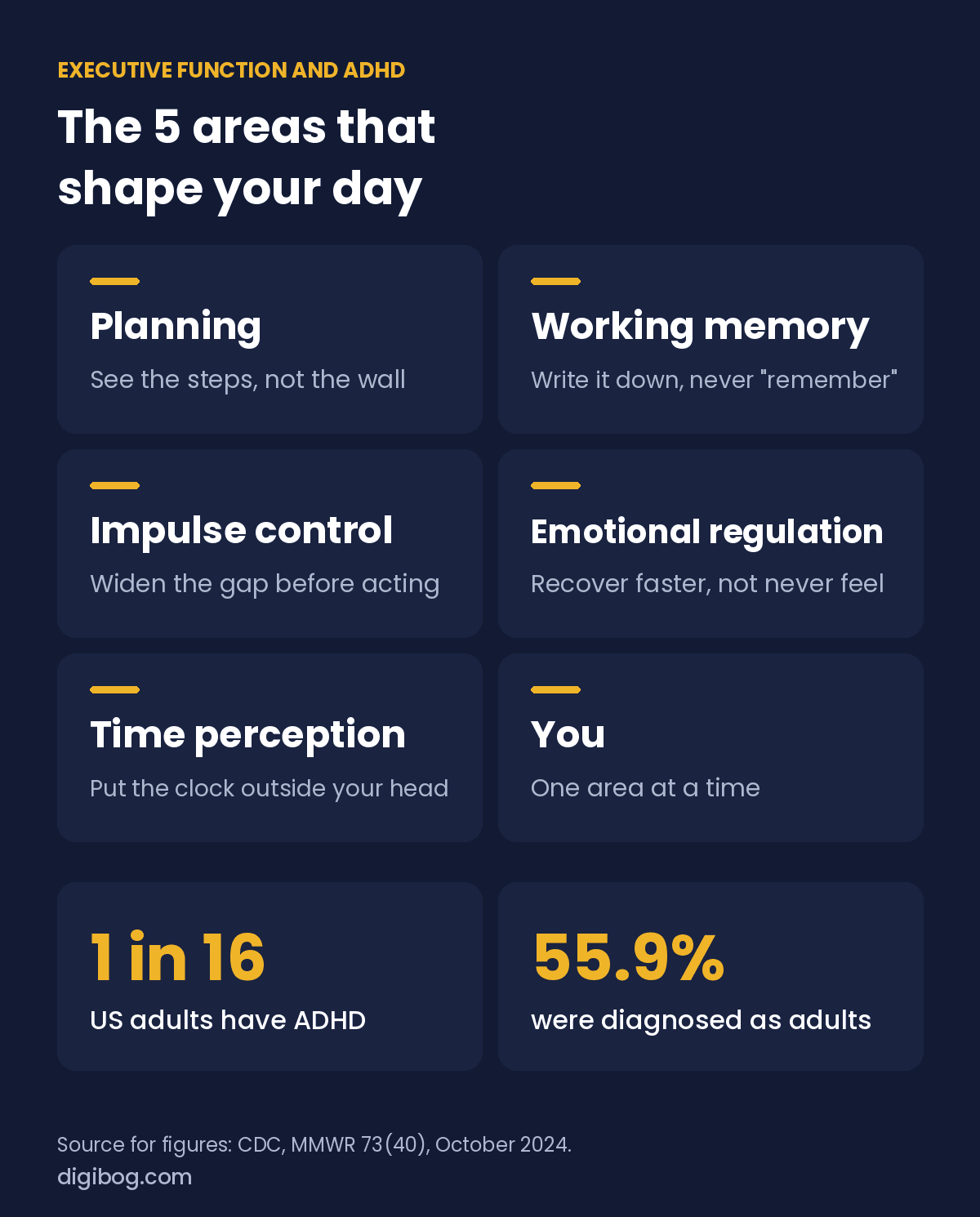

Executive function is the set of mental processes that let you plan something, hold it in mind, start it, resist distraction, and adjust when things change. With ADHD these processes do not disappear. They work inconsistently, which is far more confusing to live with than if they simply did not work at all.
It is also more common than most people assume. The CDC estimates that about 1 in 16 US adults currently has an ADHD diagnosis, and that 55.9% of them were diagnosed as adults. If you only found the words for this recently, you are in the majority, not the exception.
Researchers group executive functions in slightly different ways. The five areas below are a practical grouping: the ones that show up most clearly in a normal working day.
Executive function and ADHD: the five areas that shape your day
1. Planning and organization
This is the ability to see a goal and work backwards into steps. When it wobbles, projects feel like a solid wall rather than a staircase. You know you should start the tax return, but there is no visible first step, so the whole thing stays untouched until it becomes urgent.
What helps: see the steps, not the wall. Never write a task larger than one physical action. Not “sort out invoicing” but “open last month’s invoice folder.” The step should be so small it feels almost silly. That is the point: small steps get you past the wall.
2. Working memory
Working memory is your mental sticky note, the place you hold information while you use it. With ADHD it drops things. You walk into a room and forget why. Someone gives you three instructions and you keep the first and last. You put something down and it stops existing.
What helps: write it down, and never decide to “just remember” it. When information arrives, do one of four things with it straight away: write it down, set a reminder, act on it now, or schedule it. Your working memory is not storage. It is a workbench, and workbenches get cleared.
3. Impulse control
This is the gap between an urge and an action. When the gap is narrow, you open a new tab mid-sentence, reply to a message that interrupted deep work, or say yes to a project before checking your calendar.
What helps: widen the gap before you act, and let your environment do it rather than willpower. Willpower runs out by mid-afternoon; environment works all day. Log out of the app. Put the phone in another room. Close the tabs before you start, not when you notice you are lost in them.
4. Emotional regulation
Often the most overlooked. Emotional regulation is the ability to feel something strongly without being fully steered by it. A small piece of critical feedback can flatten a whole day. Frustration at a stuck task can tip into abandoning the project.
What helps: the goal is not to stop feeling things. It is to recover faster. Name the state before deciding anything: “I am frustrated and it is 4pm” is different information from “this project is a failure.” Make it a rule that no significant decision gets made in a spike. The feeling is real; its conclusions are usually not reliable.
5. Time perception
The internal clock runs unevenly. Twenty minutes and two hours feel similar from the inside, so estimating and planning both suffer. We cover this in depth in our piece on ADHD time blindness.
What helps: put the clock outside your head. Visible timers, written estimates checked against reality, and blocks with a defined end rather than open-ended sessions.
Executive function areas at a glance
If you only need the summary of the five executive function areas, here it is in one table. Habits that stick are covered separately in building habits with ADHD.
| Area | What it does | When it wobbles |
|---|---|---|
| Planning and organization | Turns a goal into steps | Projects feel like a wall |
| Working memory | Holds information while you use it | You forget why you walked in |
| Impulse control | The gap between urge and action | New tab mid-sentence |
| Emotional regulation | Recovers from frustration | One bad email ruins the day |
| Time perception | Senses how long things take | 20 minutes becomes 90 |
Why understanding this changes what you do
Most productivity advice assumes the management department is fully staffed. It says “just prioritize,” which requires planning. Or “remember to follow up,” which requires working memory. Or “stay disciplined,” which requires impulse control. When you apply that advice to an ADHD brain and it fails, the natural conclusion is that you failed.
You did not. You applied a tool built for a different set of conditions.
Once you can name which of the five areas is causing a specific problem, you can choose a fix that targets it. A missed deadline caused by time perception needs a different solution than one caused by working memory. Treating them the same is why generic systems keep breaking.
The five areas, worked through properly
Productivity with ADHD — Book is a 14-page reference on building focus, managing time and creating habits that fit how your attention actually behaves, rather than how a planner assumes it does.
See what is insideInstant download · unlimited downloads · no expiry · one payment, no subscriptionYour strengths are part of the same wiring
This is not a list of deficits. The same wiring that makes routine admin feel impossible is often behind hyperfocus, fast idea generation, unusual pattern spotting, and real calm in a crisis when everyone else is panicking.
The goal is not to become a neurotypical worker. It is to build a system that leans on your strengths and adds outside support where the management department is thin. Structure is not a cage. It is scaffolding, and it lets you build higher than you could unsupported.
Frequently asked questions
What is executive function in simple terms?
It is the set of mental processes that let you plan something, hold it in mind, start it, resist distraction and adjust when things change. Think of it as the brain’s management department.
Are there exactly five executive functions?
No. Researchers group executive functions in different ways. The five areas in this article are a practical grouping of the ones that show up most clearly in a normal working day.
How common is ADHD in adults?
The CDC estimates that about 1 in 16 US adults, 15.5 million people, currently have an ADHD diagnosis, and that 55.9% of them were diagnosed as adults.
Can executive function improve?
The underlying wiring does not change on command, but the cost of it can drop a lot. Outside supports such as written steps, visible timers and a calmer environment take load off the areas that wobble.
Where should I start?
With the one area causing the most trouble right now. Apply one support for it for two weeks before changing anything else.
Where to start this week: one area at a time
Pick the one area causing you the most trouble right now. Not all five. One. Apply one support for it for two weeks before touching anything else.
If you want the full framework laid out, with each area explained alongside practical strategies, our Productivity with ADHD Book covers all six chapters from executive function through habits and self-care. If you would rather work it through by writing than by reading, the Productivity with ADHD Workbook turns the same material into 22 guided exercises with room to map your own patterns. And if you want a tool to lean on, start with the best ADHD productivity tools, and how to pick just one.
Understanding why something is hard does not make it easy. But it does stop you blaming yourself for a wiring difference, and that frees up energy you have been spending on guilt.
You can browse the full Productivity with ADHD collection — book, workbook, guide, prompts, toolstack and checklist — or take all six together in the Complete Bundle.
This is an educational and organizational resource, not medical advice. If you think you may have ADHD, or your symptoms are significantly affecting daily life, a qualified healthcare professional is the right place to start.
About the author. Written by Said Sihame, founder of DigiBog. I make the planners, workbooks and checklists sold on this site, and these articles come out of the same work. I am not a clinician and nothing here is medical advice — this is an educational and organizational resource.