Day one is easy. Day two is fine. Day six you are quietly proud of yourself. Day nine something disrupts the routine, you miss it, and by day eleven the whole thing has evaporated as though it never happened. ADHD habits fail for a structural reason, not a willpower one, and the research on how habits form points to what actually works: give it months rather than weeks, and stop treating a missed day as a reset.

Then comes the part that does real damage: you decide the problem is you. You conclude you lack discipline, and that conclusion makes the next attempt harder than the last.
Habit advice built around streaks and willpower assumes a steady internal reward system. ADHD brains do not run on steady. They tend to run on interest, novelty, urgency and challenge. Build with that instead of against it and habits get considerably more achievable.
How long does it take to build a habit with ADHD?
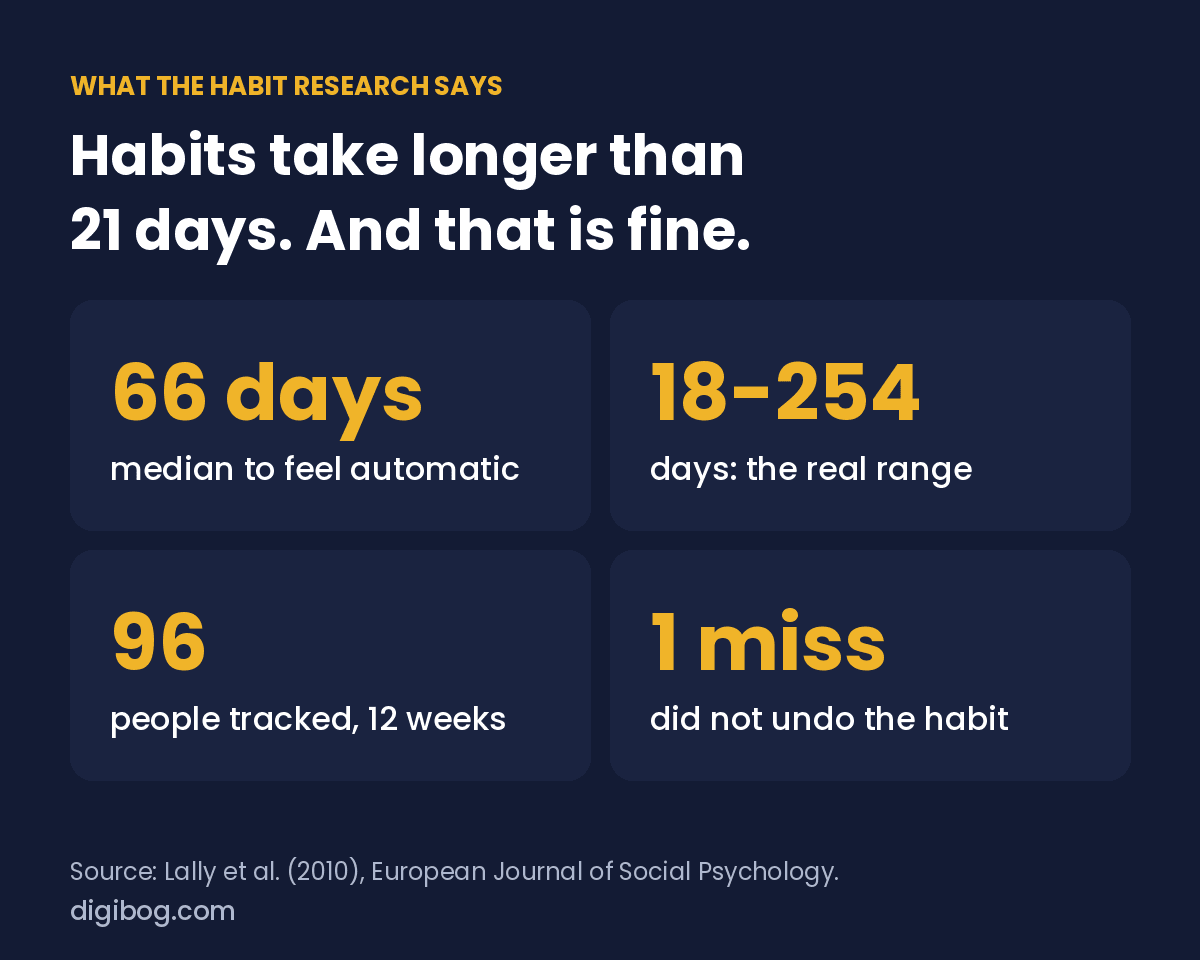
Longer than you were told, and more forgiving than you fear. In the best-known study on how habits form, researchers at University College London followed 96 people for 12 weeks, each repeating one daily behaviour of their choice. It took a median of 66 days for the behaviour to feel automatic, with a huge spread: as few as 18 days for some, and an estimated 254 days for others. Missing a single day did not materially affect the habit.
One honest caveat: that study looked at adults in general, not specifically at people with ADHD. But its findings point the same way as everything below. Expect months, not 21 days, and do not let one missed day convince you to start over.
| What you were told | What the research found |
|---|---|
| 21 days to form a habit | Median 66 days, range 18 to 254 |
| Never break the chain | Missing one day did not materially affect the habit |
| Same speed for everyone | Huge spread between people and behaviours |
| Willpower does the work | Repeating the same cue in the same context does |
Why streaks work against ADHD habits
A streak counter is motivating right up until it breaks. Then it inverts. The number that was pulling you forward becomes evidence of failure, and the most common response is not to start again at one. It is to stop entirely.
This is all-or-nothing thinking, and it is common with ADHD. A perfect record feels achievable. An imperfect record feels pointless. But the research above found that one missed day does not undo a habit. The streak counter is the only thing telling you it does.
The fix: track completions per week, not consecutive days. “Four times this week” survives a missed Tuesday. “Eleven days in a row” does not.
Make the habit smaller than feels reasonable
The usual advice is to start small. For ADHD, start smaller than that. Small enough that skipping it would be more effort than doing it.
Not “exercise for thirty minutes.” Put on running shoes. Not “write a thousand words.” Open the document and write one sentence. Not “tidy the office.” Clear one surface.
This feels like cheating. It is not. The barrier for an ADHD brain is usually not the doing, it is the starting. Once the shoes are on, the walk often happens by itself. And on the days it does not, you still did the habit, so the idea of yourself as someone who does this thing stays intact. Over 66 days or more, that is what carries you.
Design the environment, not the intention
Intentions are made the night before, when you are optimistic. They get carried out the next afternoon, when you are depleted. Environment is the one thing that stays the same between those two moments, and the habit research agrees: what builds the habit is repeating the same action in the same context, not willpower.
- Make the good thing visible and immediate. The book on the pillow. The water bottle already filled. The document already open on the screen when you sit down.
- Add friction to the alternative. Phone charging in another room. App logged out. The path of least resistance should point where you want to go.
- Attach to something that already happens. After I pour coffee, I write one sentence. Existing routines are stable anchors; abstract times of day are not.
- Use one visible cue. A single object left in an obvious place works better than a reminder that arrives while you are mid-task and gets dismissed.
Build in the reward, do not wait for it
Most worthwhile habits pay off in weeks or months, and the research says becoming automatic takes about two months on its own. That gap is hard for a brain that responds strongly to immediate feedback. If nothing good happens now, motivation fades before the results arrive.
So attach something immediate. Music you only listen to during that task. A specific coffee. Marking it somewhere you can see. It sounds trivial and it is surprisingly effective, because you are supplying the feedback your system needs rather than waiting for a payoff that is still weeks away.
Systems that survive a broken streak
Productivity with ADHD — Guide is a 6-page reference plus an 8-page fillable workbook on focus, time, habits and restarting after a bad week, built around what happens on day ten rather than day one.
See what is insideInstant download · unlimited downloads · no expiry · one payment, no subscriptionPlan for the bad days before they arrive
Every habit meets a day where energy is gone, the routine is broken, or life simply gets in the way. If your only option is the full version, you will do nothing and convince yourself the habit is over.
Define three versions in advance:
- Full: what it looks like on a good day.
- Reduced: roughly half, for an average day.
- Minimum: the smallest version that still counts, for the worst day.
A thirty-minute workout becomes fifteen minutes becomes five minutes of stretching. All three count. The habit continues, which is the whole point, because what you are protecting is not today’s output. It is your belief that you are someone who does this.
If your habit keeps failing at the same time of day, the cause is often energy and time blindness rather than motivation.
Restart without the ceremony
You will miss days. The research says one miss does not undo the habit, so the measure of a good system is not whether it breaks but how quickly you resume.
Skip the post-mortem. Skip waiting for Monday. Skip the fresh notebook and the redesigned system, which are procrastination wearing a productive costume. Just do the minimum version today, and let that be the restart.
Work it through on paper
Habits are hard to design in your head, because the useful details are specific: your actual cues, your actual energy pattern, your actual failure points. Writing them down turns vague intentions into something you can test.
Our Productivity with ADHD Workbook includes guided exercises for exactly this: mapping your energy, designing habits with full, reduced and minimum versions, and reviewing what actually held. If you want a shorter starting point, the Productivity with ADHD Checklist walks through thirteen steps with a weekly reset built in. And if a tool would help carry the load, see the best ADHD productivity tools.
Frequently asked questions
How long does it take to build a habit?
In the best-known study, a median of 66 days for a daily behaviour to feel automatic, ranging from 18 days to an estimated 254. That study looked at adults in general, not specifically at people with ADHD.
Does missing one day reset a habit?
No. In the same study, missing a single day did not materially affect the habit. The streak counter is the only thing that says otherwise.
Should I use a streak app?
Track completions per week instead of days in a row. “Four times this week” survives a missed Tuesday; “eleven days in a row” does not.
What is a minimum version of a habit?
The smallest version that still counts on your worst day. Five minutes of stretching instead of a thirty-minute workout. Doing the minimum keeps the habit alive.
Why do I start strong and quit after a week?
The novelty that powered the first few days fades long before the habit becomes automatic. Building in an immediate reward and planning the bad days in advance carries you through that gap.
The part worth remembering
You are not failing at habits because you lack discipline. You are using a method built for a different reward system, on a timeline that was never realistic.
Make it smaller. Make it visible. Reward it now. Plan the bad day. Restart without ceremony. Give it months, not 21 days. Consistency at fifty percent beats perfection you abandon in week two, every single time.
You can browse the full Productivity with ADHD collection — book, workbook, guide, prompts, toolstack and checklist — or take all six together in the Complete Bundle.
Related reading: Why Your To-Do List Keeps Failing You (And What an ADHD Brain Needs Instead).
This is an educational and organizational resource, not medical advice.
About the author. Written by Said Sihame, founder of DigiBog. I make the planners, workbooks and checklists sold on this site, and these articles come out of the same work. I am not a clinician and nothing here is medical advice — this is an educational and organizational resource.